
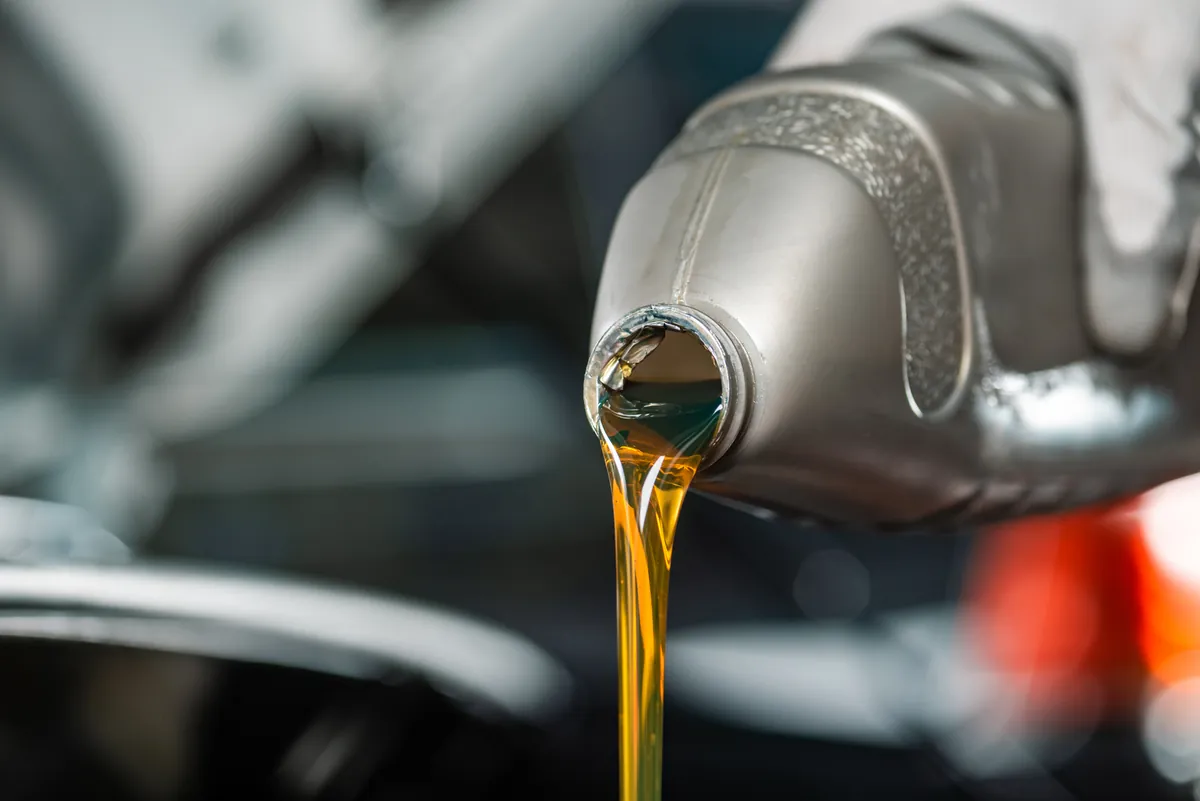
What exactly is this fluid that matters so much to cars, and what is it for? Read on.
Lubricating oils are a sophisticated blend of refined or synthetic base oils and high-performance additives. They place themselves between moving surfaces (in machines and engines), forming a thin film over the metal to avoid or minimize contact (friction) between the parts, and therefore wear and heat, while also helping to seal the engine, for example.
Types of lubricants
Mineral lubricants are obtained by distilling crude oil. Synthetic ones are produced in laboratories from several components, and semi-synthetic ones are blends of mineral and synthetic oils.
Characteristics of lubricants
The main characteristics are:
1) Viscosity
Viscosity is a fluid's resistance to flow. Viscosity measures how hard it is for the oil to run. The more viscous (thicker) a lubricant is, the harder it flows, and the better it stays between two parts to lubricate them. But viscosity is not constant. Temperature is the main factor: as temperature rises, viscosity drops and the oil flows more easily. The Viscosity Index (VI) measures how viscosity changes with temperature: the higher the index, the less the lubricant's viscosity varies across temperatures.
For automotive use, the Society of Automotive Engineers (SAE), in the United States, created a criterion that classifies oils by viscosity with a number. The higher the number, the more viscous the oil; the lower the number, the more fluid it is. The SAE classification for engine oils goes from 0W to 25W, where W stands for “winter” and indicates an oil treated to stay fluid at low temperatures, that is, how well it flows at a cold start.
A multigrade oil rated 20W50, for example, behaves like a 20W oil at a cold start and like a 50 when hot. A wider gap between these figures means more flexibility under extreme temperatures.
2) Additives
Another classification is the API rating, developed by the American Petroleum Institute, which defines the oil's additive level. Additives are chemicals blended into the oil in balanced proportions to improve its performance. The rating is based on performance levels, that is, on the kind of service the engine or machine will face. Engines are filled with the lubricant under evaluation and run under strictly controlled conditions.
The test sequence sets the internal standards and conditions the engine must show after running on the test lubricant, covering protection, component wear, cleanliness, contamination and more. The rating uses two letters. The first one defines the service: “S” for Service Station (spark ignition, the type of engine in modern cars). The second one defines the performance. Today, oils for four-stroke ethanol, gasoline and natural gas engines are rated from SL to SP, where L is the minimum additive level currently required by Brazil's National Petroleum Agency (ANP) and P is the highest and most complete on the market.
In other words, the further along the alphabet, the greater the oil's protection and cleaning power and the higher its performance. Diesel engines follow the same logic with a different naming: the most common oils use C for the service (“compression”) and D, E, F, G or H for the additive level. Numbers were added to indicate the engine type (two- or four-stroke). CK-4, for example, is the latest and most modern rating.
Summary of the classifications
Other international organizations also classify lubricants in equivalent ways. In short:
- SAE: the oldest classification, with one scale for engine oils and another for gear oils. It standardized the viscosity naming of lubricants.
- API: American Petroleum Institute, which created the specifications that define the performance levels lubricants must meet; in practice, it standardized the naming of additive levels.
- ACEA: European Automobile Manufacturers' Association, the European classification, equivalent to the American API.
- JASO: Japanese Automotive Standards Organization, the Japanese classification. It also rates two-stroke engine oils (FA, FB, FC).
- ILSAC: International Lubricant Standardization and Approval Committee, a joint body of American and Japanese carmakers that sets minimum performance levels for engine oils.
- Carmaker approvals: each carmaker also has its own specifications, approving oils under its own registered numbers in addition to the API or ACEA ratings, depending on the country of origin. For example: Volkswagen VW 502.00/505.00 corresponds to 5W30; Renault/Citroën corresponds to ACEA A3; GM (USA) uses API; ACEA (Europe) = API (USA); ACEA A2 = API SL; ACEA A1/A3 = API SM; ILSAC GF-5 = API SN.